

Structure Levels
Understand BOS, CHoCH, internal structure, and external structure inside Atlas Pro.
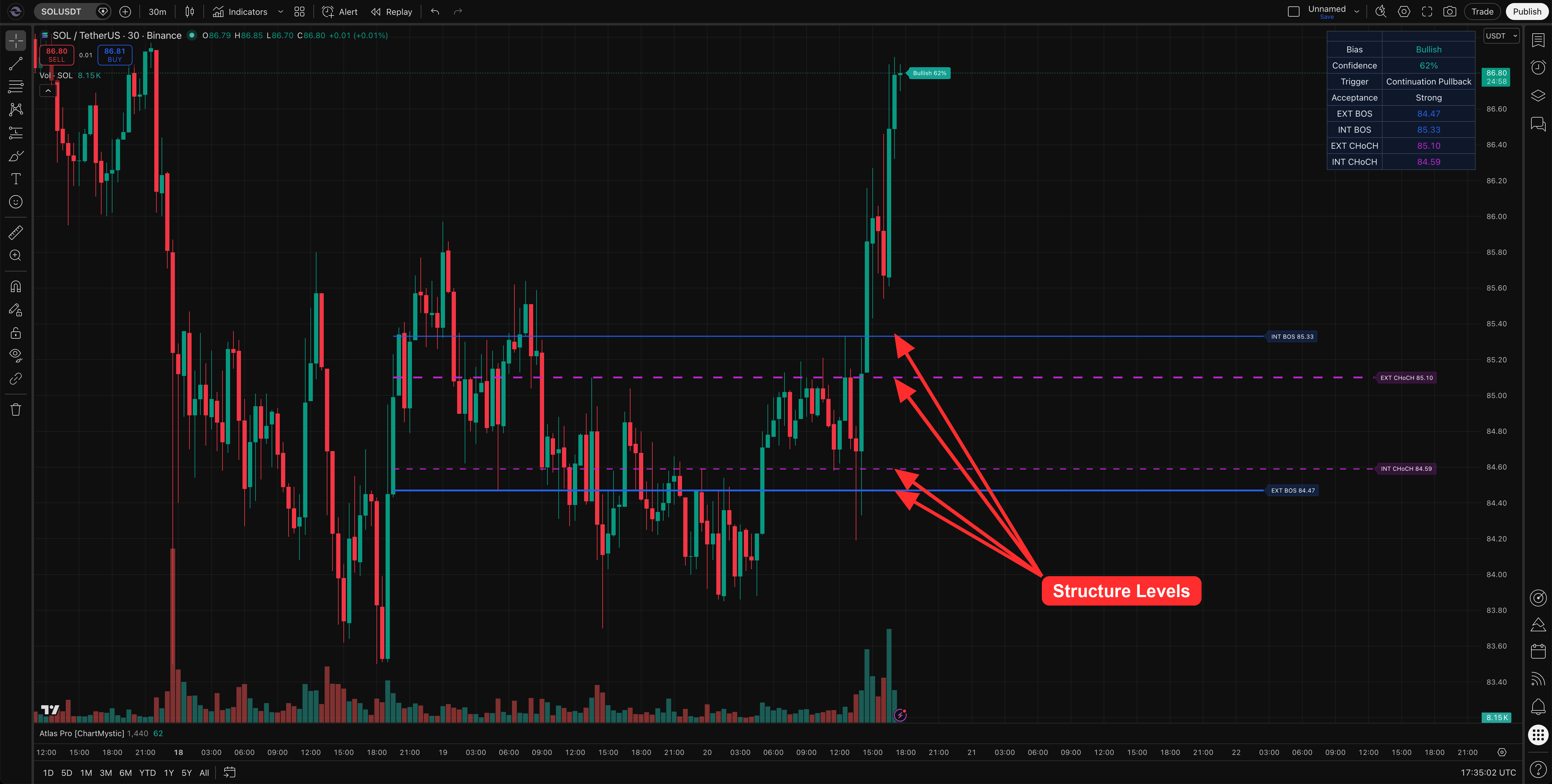
Structure Levels are the chart's load-bearing geometry. Atlas Pro draws four labels — EXT BOS, INT BOS, EXT CHoCH, INT CHoCH — so you can see at a glance whether price is continuing the prevailing structure or breaking character against it.
Structure Levels mark Break of Structure (BOS) and Change of Character (CHoCH) events on the chart, including both internal and external structure.
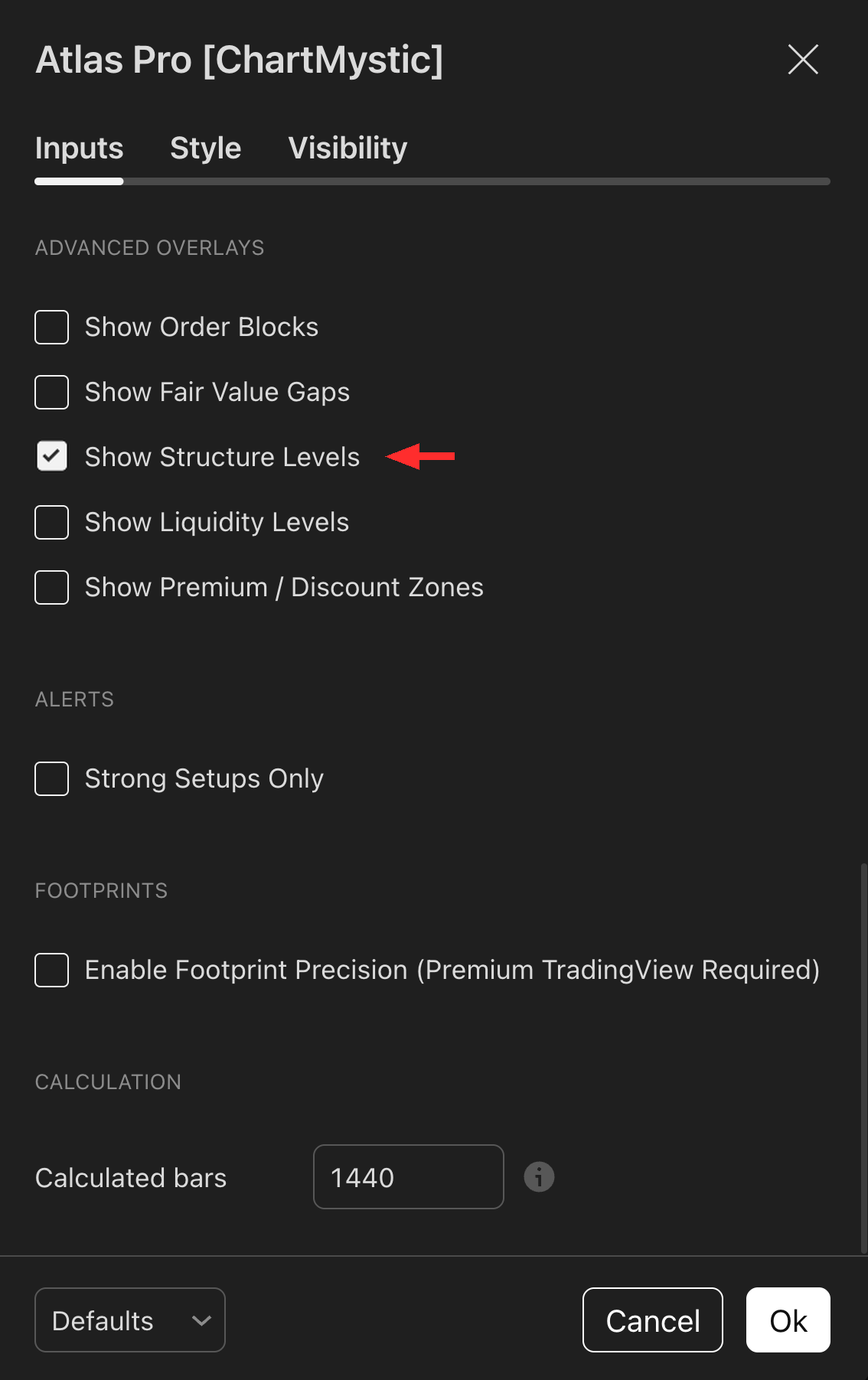
Enable Show Structure Levels under the Advanced Overlays section to render the lines. External BOS / CHoCH represent the broader trend; internal lines mark intermediate shifts inside that trend.
The Two Structure Events
BOS (Break of Structure). Price breaks a prior structural level in the direction of the active move. A bullish BOS prints when a new higher high closes through the most recent swing high; a bearish BOS prints when a new lower low closes through the most recent swing low. BOS is continuation.
CHoCH (Change of Character). Price breaks a structural level in the opposite direction of the prior swing structure. A bullish CHoCH after a downtrend is the first close back above the prior swing high; a bearish CHoCH after an uptrend is the first close below the prior swing low. CHoCH is the earliest structural sign that the prevailing character is shifting.
A CHoCH is not yet a confirmed reversal — it is the first crack. A subsequent same-side BOS is what most traders treat as the confirmation.
External vs Internal Structure
Atlas Pro separates structure into two scales, and the distinction matters more than the labels suggest.
External structure is the broader swing structure that defines the active range or trend at the timeframe you are reading. It is the structural layer most aligned with higher-timeframe context. An external BOS or CHoCH is a meaningful event.
Internal structure is the more local swing structure inside that external frame. Internal events are useful for timing pullbacks and early-warning shifts, but they happen more often and individually carry less weight than external events.
When external and internal structure agree, the chart is clean. When they disagree — for example, an internal CHoCH inside an intact external uptrend — you are looking at an early-stage transition, not a confirmed broader shift.
How Atlas Pro Uses Structure Levels
Structure feeds setup context, trigger interpretation, invalidation anchoring, and dashboard output. When the overlay is on, the dashboard surfaces EXT BOS, INT BOS, EXT CHoCH, and INT CHoCH rows showing the most recent event of each type. These are not a structure textbook — they are coordinates. They tell you which structural level is currently load-bearing so you can connect the signal to the chart.
How To Enable Structure Levels
- Open Atlas Pro settings.
- Go to Advanced Overlays.
- Toggle Show Structure Levels on.
How To Read Structure Levels
Five questions worth asking:
- Is price breaking structure or reacting inside it?
- Is the current Atlas Pro read aligned with the structural context, or fighting it?
- Did the confirmed signal print after a meaningful structure event, or in dead space?
- Is the Invalidation Line sitting near a structural boundary?
- Are external and internal structure saying the same thing, or is the chart mixed?
Avoid over-reading every minor label. Structure earns its weight when it lines up with the rest of the evidence.
Example Use
A confirmed Bullish 76% signal prints two bars after an external BOS to the upside, and the dashboard shows Strong acceptance. The setup has structural backing — the break, the acceptance, and the directional read all agree.
An internal CHoCH bearish prints inside an intact external uptrend. This is an early-warning shift, not a confirmed reversal. Wait for confirming internal BOS bearish, then external CHoCH, before treating the structural character as fully flipped.
Common mistakes
- Treating internal CHoCH as reversal confirmation. Internal events come and go. External structure is what defines the regime.
- Trading every BOS label. Continuation BOS in the middle of an already-extended move can be the late-cycle break, not the early one.
- Ignoring mixed structure. When external and internal disagree, the chart is in transition — that is the moment to size smaller, not bigger.