ChartMystic
  • How it works
  • Products
  • Live demo
  • Results
  • Pricing
  • Docs
Log inSign up
  • How it works
  • Products
  • Live demo
  • Results
  • Pricing
  • Docs
  • Log in

Documentation

Artemis Pro

InstallationOverviewHow Artemis Pro ThinksReading The ChartTrend EngineSignal ReferenceLiquidity LinesLiquidity GrabsSession BoxesHTF LevelsHTF CandlesHTF Info TableBacktesting And Data WindowSupported Markets And ChartsSettings ReferenceFAQGlossary

Scribe Studio

OverviewAsk for a StrategyPerformanceTrade AnalysisCodeTweaking Your StrategyTransfer to TradingViewThe Strategy LibraryHistory & Saved StrategiesFAQGlossary
ChartMystic
Documentation/Scribe Studio/Ask for a Strategy

Ask for a Strategy

Everything you can type or click in the chat, and what comes back.

The chat is where every strategy starts. Describe what you want in plain English and Scribe builds a strategy to match, backtests it, and replies with a summary while the full report opens in the results panel.

Three Ways to Start

Press a starter chip. A fresh chat opens with a row of ready-made requests: "Build me a stock strategy", "Momentum pullback strategy", "I want a TSLA strategy", "An ETF strategy", "Build me a forex strategy", "A swing trading strategy" and "Give me something unusual". The market behind a chip changes from chat to chat, so pressing the same chip in a new chat gives you a different market.

Type a request. The message box reads "Describe a strategy". Type what you want and press Enter or the send button.

Open a strategy you already have. From The Strategy Library, or from Saved Strategies or History.
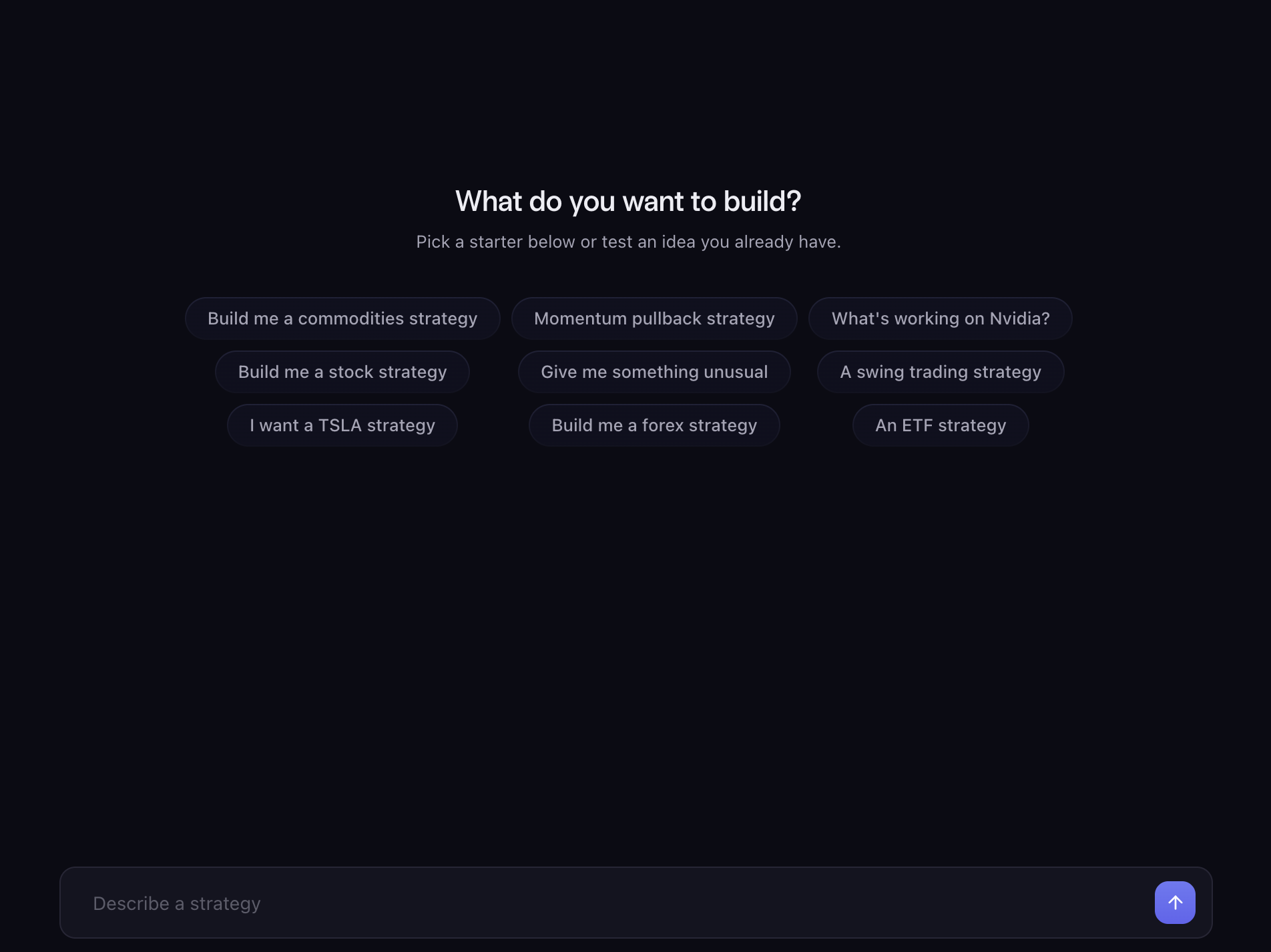
A new chat
Screenshot
An empty chat with the starter chips and the message box reading Describe a strategy

Writing a Request

A request can be as short as a market name or as detailed as a full rule set. The more you say, the more precisely Scribe can build.

Name the market. A ticker or a name both work: "TSLA", "Tesla", "S&P 500", "gold", "EURUSD". Write tickers in capitals; a leading $ is fine too. If you name a market Scribe does not cover, it tells you and lists what is available.

Name a timeframe, if you care. 15m, 1h, 4h or 1d. Scribe also understands "15min", "60m", "hourly", "4hr", "daily" and "D". If you do not name one, Scribe picks and tells you which it picked.

Describe the rules, if you have them. Say what triggers a trade, any condition that has to be true, and which side to trade.

Example requests
PreviousOverviewNextPerformance

Need help?

"Buy TSLA on the 1h when RSI(14) crosses up through 30, only while price is above the 200 EMA."

"A MACD crossover strategy on SPY, daily, long and short."

"Breakout of the 20-bar high on EURUSD, 4h, with a volume filter."

Say long, short or both. If you do not, and it matters, Scribe asks.

Add a performance requirement, if you have one. "Low drawdown", "high win rate", "drawdown under 20%", "win rate above 60%", "profit factor above 1.5", "at least 40 trades". Scribe builds toward it and tells you before the summary whether the result met it, for example "Max drawdown −14%, inside the 20% ceiling you asked for", or a "Heads up" line when the strongest result it could produce falls short of your number. "Low drawdown" on its own means under 20%; "high win rate" on its own means above 55%. A number you state always wins over a word.

Keep requests to price and volume. Strategies read the chart, so ideas that need news, earnings, sentiment or other outside data cannot be built, and Scribe says what the idea would need.

Running a Backtest of Your Own Rules

Include the word backtest or test in your message and Scribe runs your rules straight away:

Example

"Backtest a 9/21 EMA cross on NVDA, 4h, long only."

Without that word, when a message reads like an idea to test, Scribe shows a Run backtest button instead of running it. Press it when you are ready.

While the backtest runs, a tracker appears in the chat with four steps: reading your rules, loading the market's history, walking the bars trade by trade, and checking the script. A progress bar runs underneath. Press Stop to cancel. If a run takes longer than usual the tracker says so and keeps going. When it finishes, the tracker reads something like "1,240 bars checked · 87 trades" and the summary follows.

What Comes Back

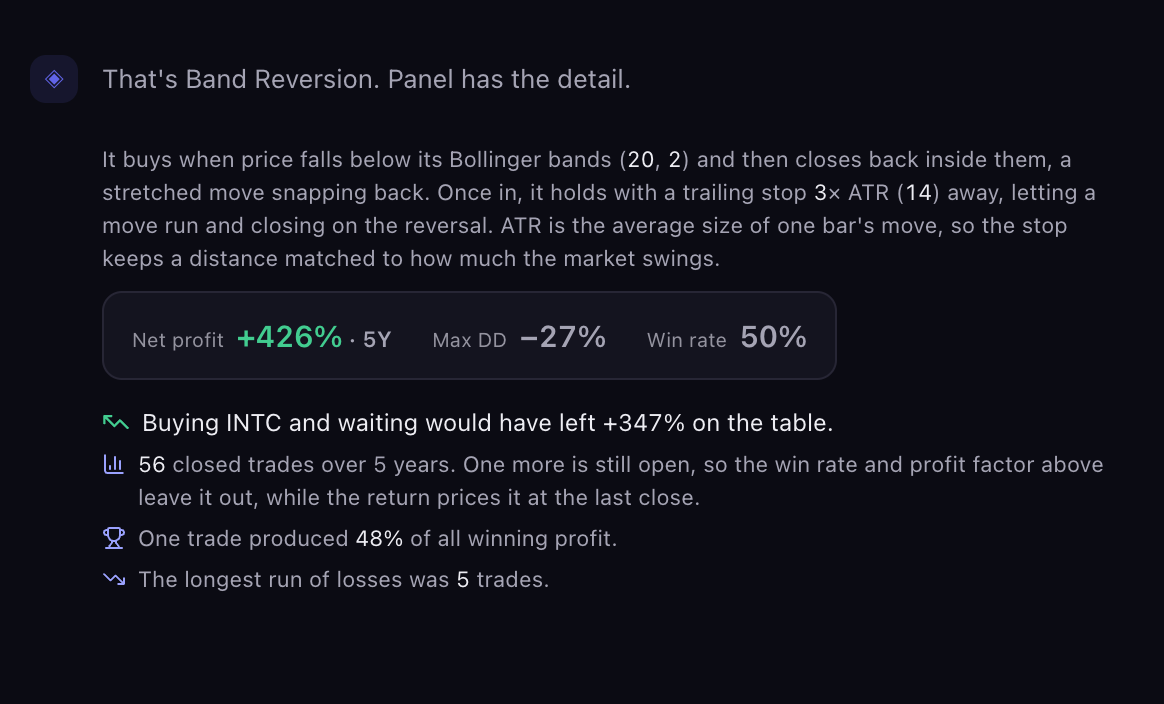
Scribe replies with a short line ("Here's Trend-Confirmed Oversold Turn. The full picture is on the panel.") and a summary beneath it:

  • The name and a sentence or two on how the strategy enters and exits.
  • The headline box: Net profit with the period it was measured over, Max DD, and Win rate.
  • How it compares to simply holding the market over the same stretch. Scribe says "holding would have paid more" as readily as the opposite.
  • The sample size: how many closed trades over how long. If the sample is thin, the summary says so.
  • Where the profit came from (the share made by the single best trade) and the longest losing streak, when they are worth stating.

The full report opens in the results panel: the equity curve, the metrics, every trade, and the code. Performance is the place to start reading it.

A reply and its summary
Screenshot
One reply in the chat: the short line and the summary beneath it, cropped to the chat column

Notes You May See Above a Summary

Scribe says these before the numbers, so you read the caveat first.

What it saysWhat it means
"You didn't name a timeframe, so this is the 1h run. Name one and I'll pin it there."You left the timeframe open. Say one to change it.
"Nothing lined up on 15m, so this is the closest fit: 1h."Scribe could not produce a result on the timeframe you named, so it moved to the nearest one.
"You've already seen the strongest match for this, so here's the next one."You asked the same thing recently. Scribe gives you the next-best rather than repeating itself.
"… Here's the closest fit."Scribe could not build your rules exactly as written. The note says what it changed. Say backtest to have your exact rules built and tested instead.
"No SPY results yet, so here's a … strategy as an example."Scribe could not answer for the market you named and is showing a stand-in.

New Chat in the sidebar starts a fresh conversation. The one you were in is kept under History.