ChartMystic
  • How it works
  • Products
  • Live demo
  • Results
  • Pricing
  • Docs
Log inSign up
  • How it works
  • Products
  • Live demo
  • Results
  • Pricing
  • Docs
  • Log in

Documentation

Artemis Pro

InstallationOverviewHow Artemis Pro ThinksReading The ChartTrend EngineSignal ReferenceLiquidity LinesLiquidity GrabsSession BoxesHTF LevelsHTF CandlesHTF Info TableBacktesting And Data WindowSupported Markets And ChartsSettings ReferenceFAQGlossary

Scribe Studio

OverviewAsk for a StrategyPerformanceTrade AnalysisCodeTweaking Your StrategyTransfer to TradingViewThe Strategy LibraryHistory & Saved StrategiesFAQGlossary
ChartMystic
Documentation/Scribe Studio/The Strategy Library

The Strategy Library

Browse, filter and open ready-made strategies, each with its rules, its results and its code.

The Strategy Library is a browsable collection of strategies Scribe has already built and backtested, each with its rules, its full results and its code. Every strategy listed was backtested and was profitable over its test period. Find it under Scribe Studio in the sidebar.

Use the library when you would rather browse than ask: to scan what works on a market, to compare timeframes, or to pick a starting point to tweak.
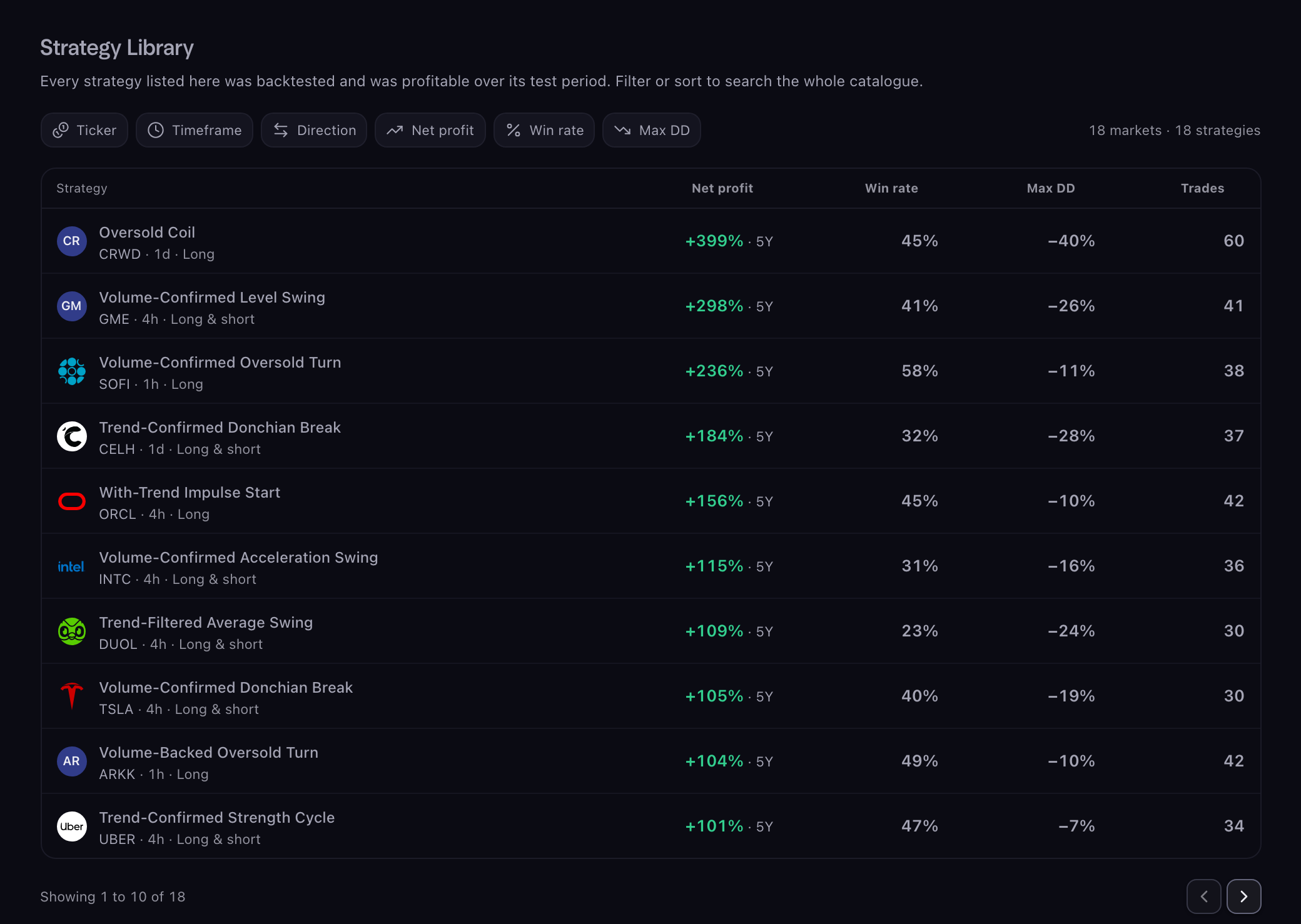
The Strategy Library
Screenshot
The library on open: the six filter chips, the count line, the sortable table and the pager

The Table

The library opens on Best per ticker: one strategy for each market, so you can scan the whole range at a glance. The moment you filter or sort, the table switches to the full list, and the count line above it says how many markets and strategies the library holds.

Each row shows the market's mark, the strategy's name, its ticker, timeframe and direction (Long, Short, or Long & short), then Net profit with the period it was measured over, Win rate, Max DD and Trades.

Filters

Six chips above the table. Press one to set it; a set chip fills in and shows its value, with an × to clear it. Clear filters clears them all and brings back Best per ticker.

  • Ticker. Tick one or more markets. Type in the search box to narrow the list. This is also the full list of markets Scribe covers.
  • Timeframe. Tick one or more of 15m, 1h, 4h, 1d.
  • Direction. Long, Short, or Long & short. Applies the moment you pick.
  • Net profit. Above or below a percent.
  • Win rate. Above a percent.
  • Max DD. Below a percent. "Below 20%" means a drawdown shallower than 20%.

Ticker, Timeframe and the numeric filters take effect when you press Apply. "Above 30%" means strictly above; a strategy sitting exactly on 30% does not qualify. Filters combine: every set chip must match.
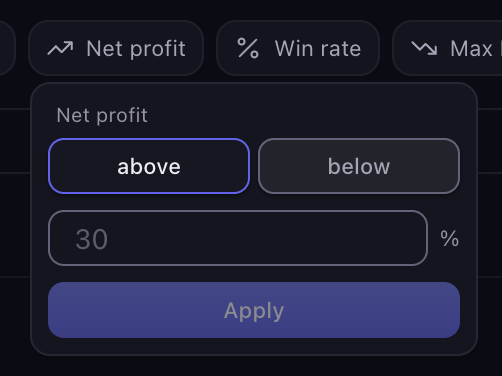
The net profit filter open in its chip editor, with the above and below modes and the Apply button
PreviousTransfer to TradingViewNextHistory & Saved Strategies

Need help?

Visual referenceA numeric filter

The Net profit chip open: choose above or below, type a percent, and press Apply.

Sorting

Click Net profit, Win rate, Max DD or Trades in the table header to sort by it. The first click puts the best rows on top; click again to flip the direction, and the arrow shows which way. On a phone, where the table becomes a list of cards, use the Sort chip instead. It also has Best per ticker to get back to the opening view.

Sorting by net profit takes you to the strongest returns in the library. The rows at the top of that list deserve the closest reading: check their sample size and where their profit came from on the Trade Analysis tab before trusting the headline.

Opening a Strategy

Click a row. The studio opens with that strategy in the results panel, everything the row summarized now in full, and the chat asks "What next?": tweak it, ask what it does, or run it on another market.

If no strategy matches your filters, the library says so. Clear one to widen the search. An empty filtered list means nothing in the library matches those filters; it does not mean the market is unavailable. To have Scribe build something for that market instead, ask for it in the chat.

Every return here is a backtest

Backtested on historical data. Past performance doesn't predict future results. The full risk disclosure states the terms.